
Requirement Elicitation
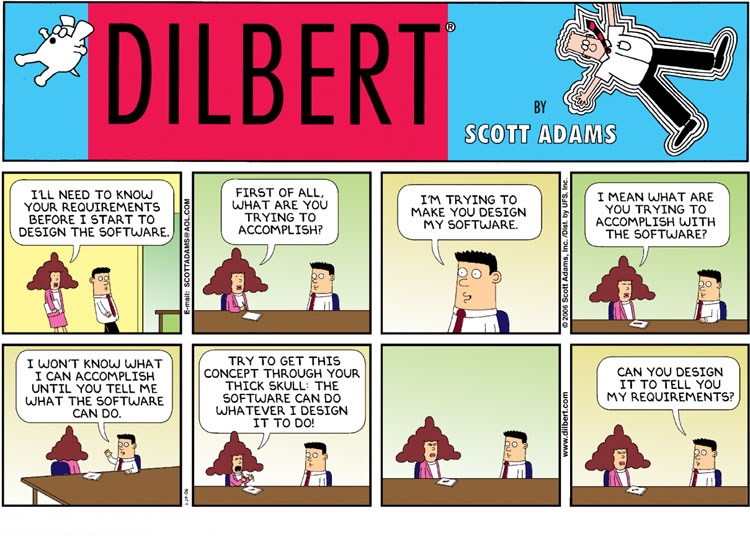
Some of the challenges associated with requirement gathering or elicitation happens in the development life cycle. During the beginning stages, it is of the utmost importance to get a good grasp of the requirements. Getting the requirements wrong or not properly captured can set a project up for failure from the beginning.
This YouTube video is funny because some of us have been there: https://www.youtube.com/watch?v=lXNu0VBVCUc
Requirements gathering is all about determining the needs of the stakeholders to solve a problem or achieve an objective. Once the needs have been identified, then it’s a matter of succinctly identifying the specific requirements while minimizing any assumptions. Sometimes an iterative approach helps the process by continuously checking in with the stakeholders throughout the project to determine if the progress is meeting their requirements. The amount of iteration depends on the complexity of the project.
Requirements can be broken down into functional and non-functional requirements. A functional requirement specifies what the system should do. A non-functional requirement specifies how the system should behave. A method for requirement prioritization is the MoSCoW technique in which you break up the requirements into:
- MUST (M)
- SHOULD (S)
- COULD (C)
- WON’T or WOULD ( W )
This is a good step to help prioritize those requirements so that you know what to focus on the most, which is the must haves. On top of the requirements you also can’t forget the assumptions, constraints, and risks.
Resources:
- RFC to Indicate Requirement Levels: http://www.ietf.org/rfc/rfc2119.txt
- Functional vs Non-Functional Requirements: http://communities.vmware.com/docs/DOC-17409
- BABOK Key Concepts: http://www.iiba.org/babok-guide/babok-guide-v2/babok-guide-online/chapter-one-introduction/1-3-key-concepts.aspx
 Digital4n6.me